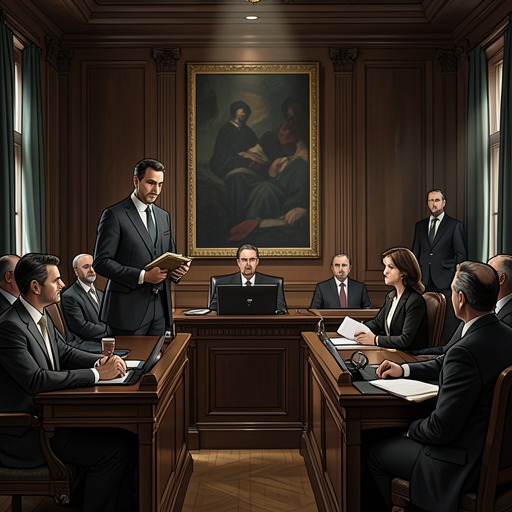
Ron Lafferty’s contested mental competence
Under the Banner of HeavenRon Lafferty’s contested mental competence shaped the legal course of his prosecution for the murders of Brenda Lafferty and her infant daughter, Erica. The dispute was not simply whether Ron understood that he had been charged: it was whether his religious convictions allowed him to understand the case against him realistically, and whether those convictions were sincere expressions of faith or delusions that impaired his capacity to stand trial.
The legal question
Ron’s position that he answered to God’s law rather than man’s law became central to the dispute over his competence. In 1991, the Tenth U.S. Circuit Court of Appeals vacated his 1985 convictions after concluding that the state trial court had applied a faulty standard when it found him competent. The appeals judges accepted that he understood the charges and their possible consequences, but concluded that his paranoid delusional system kept him from interpreting them realistically. The court required the state to reassess his competence under accepted legal criteria before trying him again.
That ruling left a difficult boundary unresolved. If Ron’s obedience to what he believed was God’s voice counted as evidence of mental illness, what separated his beliefs from religious faith more generally? The book frames the problem as a collision between religious freedom and criminal law: a democratic society protects belief, yet must decide when a professed religious command is evidence of a delusional system rather than a defense for violence. The case thus raised questions with implications beyond Ron’s prosecution, including concern that a competence ruling might make some religiously motivated crimes harder to prosecute.
Competing psychiatric accounts
When the case returned for retrial in 1996, Ron’s lawyers relied on an insanity defense they had wanted to use in 1985 but Ron had then forbidden. His life would turn on whether jurors accepted that his belief that God had commanded the removal of Brenda and Erica was both sincerely held and so extreme that it arose from a diseased mind. The defense called three psychiatrists and a psychologist; the prosecution presented one psychiatrist and three psychologists who argued that Ron was sane and had known what he was doing.
Defense psychiatrist C. Jess Groesbeck connected Ron’s deterioration to the departure of his wife, Dianna, with their children. He testified that Ron could not tolerate the loss and developed what Groesbeck described as a schizo-affective or delusional disorder. In his account, Ron’s extraordinary beliefs could not be changed by reason and reflected a new, unreal view of himself and the world.
Groesbeck also argued that Ron could not properly evaluate the state’s case. Ron believed that the evidence against him had been planted; the defense presented this as an expression of a delusional system so powerful that he could not appreciate the charges. Clinical and forensic psychologist Robert Howell supported Groesbeck’s opinion that Ron suffered from a delusional disorder that left him incompetent to stand trial. The prosecution’s experts reached the opposite conclusion, putting the jury between sharply conflicting professional assessments rather than a settled diagnosis.
Conduct and interpretation
Ron’s behavior during pretrial hearings gave the defense another basis for its argument. He wore a cloth sign marked EXIT ONLY on his prison jumpsuit to ward off what he believed was an evil spirit attempting to invade his body. He also believed the spirit had taken possession of Judge Hansen, and directed profanities at the judge. The book presents these actions as part of the evidence considered in the competence dispute, not as a resolution of it: the meaning of unusual religious claims and conduct remained contested.
That uncertainty was complicated by the fact that Ron and Dan Lafferty described the killings as obedience to divine direction. A court had to assess the effect of Ron’s beliefs on his ability to participate in his defense without treating religious conviction itself as proof of illness. At the same time, the claimed command concerned the removal and killing of Brenda and Erica, making the distinction between belief and delusion a question with immediate consequences for criminal responsibility.
Verdict and significance
After four weeks of testimony, the jury deliberated for five hours and, on April 10, 1996, found Ron guilty of first-degree murder and related charges. The verdict repeated the outcome of his first trial, eleven years earlier, after the appellate court had set those convictions aside on competency grounds. It resolved the retrial in the state’s favor but did not erase the underlying tension: the legal system had to judge a defendant whose account of divine command was presented both as religious belief and as evidence of mental disorder.
The case’s significance lies in that double demand. The court had to consider whether Ron could realistically understand and answer the charges, while the jury had to decide whether his claimed religious motivations excused his participation in the murders. The 1991 ruling and 1996 conviction mark two different stages of the same question: first, whether the original competence assessment was legally sound; then, whether competing accounts of Ron’s mental state could persuade a jury at retrial.